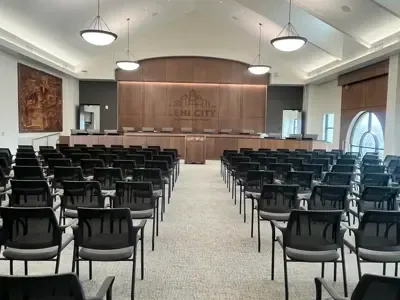
The Lehi City Council rejected a straight rezoning of a 2.58-acre residential property at 915 West State Street to heavy commercial on Tuesday, July 14, but left the door open for the Walker family to return with a developer agreement that would restrict future uses on the parcel.
The vote killed Ordinance #27-2026, filed by Deborah Walker on behalf of her family. The Walkers sought to sell their deceased parents' property to a local developer planning a mixed-use complex of offices and warehouses. The house, Walker told the council, is in disrepair and needs new plumbing and electrical work.
"We love Lehi, but we have to reconcile our parents' estate, and that means selling the property," Debbie Walker said at the July 14 meeting. "It's time."
The parcel faces State Street and is surrounded by commercial properties. Lehi's 2022 General Plan identifies the State Street corridor as an "Area of Change" where commercial development is expected. But the property also backs up to Trinnaman Lane, a residential street, and that boundary drove the opposition.
About 25 neighbors turned out to oppose the rezoning during nearly an hour of public comment. Kyle Welch, who lives adjacent to the Walker property and bought his home about a year before the hearing, told the council the rezoning would hurt his family and neighborhood. His wife Michelle raised safety concerns for their children.
Neighbor Kristen Goodwin, a three-year resident of the area, cited cumulative impacts: noise from HADCO Construction, increased traffic noise from I-15, and a UTA park-and-ride at 2100 North.
Council members zeroed in on a core problem. Heavy commercial zoning is permanent. It follows the land, not the developer. Under Lehi City code, C-H zoning does not limit building size as long as buffering standards are met. Any future buyer could build anything the zone allows.
Council member Heather Newall said she was "having a hard time seeing anything in heavy commercial so close to residents," even with a 75-foot buffer. Council member Emily Lockhart proposed a developer agreement as a compromise, a tool that would let the city narrow what heavy commercial means on that specific parcel and set boundaries for future owners.
Walker said the family rejected earlier proposals for high-density housing and a shopping center before settling on the office-and-warehouse concept. She agreed to return with a developer agreement.
The Walker Zone Change was heard by the Lehi Planning Commission on Thursday, June 11, before moving to the full council.
Both city officials and the Walker family's representatives will now draft the developer agreement for presentation at a future council meeting. No date has been set. Residents can monitor the agenda at lehi-ut.gov.